GSDC

  • Decrease font size
  • Default font size
  • Increase font size
Home In the News GSDC news Front Page Blog News "Keep Our Homes" Anti-Foreclosure Campaign Update
"Keep Our Homes" Anti-Foreclosure Campaign Update PDF Print E-mail

ENews---KOH-logo.gif

The lead story in GSDC's last newsletter was about the Keep Our Homes (KOH) Campaign that was launched on the southwest side by the Greater Southwest REACH Center, NHS Chicago Lawn and the Southwest Organizing Project (SWOP) to help the community fight the foreclosure crisis. These partners have been instrumental in  the great strides that have been made in the KOH Campaign over the last few months.


Under the leadership of SWOP and NHS Chicago Lawn, there have been numerous meetings in the St. Nicholas of Tolentine and St. Rita's Parishes to educate its members about the KOH Campaign and to provide assistance to those who may be in the midst of or threatened with foreclosure. Close to 900 parishioners completed surveys that asked them to describe their housing situation, and then they were offered the chance to get counseling and have their questions answered. So far, the KOH Campaign has helped 13 families save their homes from foreclosures and there are over 100 cases in progress of being resolved. 

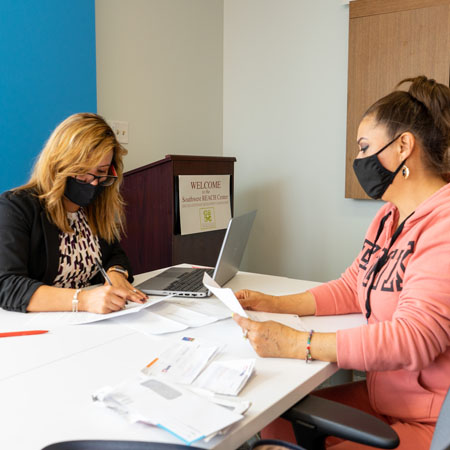
In December, the Greater Southwest REACH Center hosted an information meeting at Eberhardt School.  SWOP will start meeting soon with St. Mary's Star of the Sea Parish, and all partners will begin outreach to local schools and community organizations.

Sen. Durbin before foreclosure mapAs part of the KOH Campaign, SWOP and NHS Chicago Lawn have identified several banks that hold mortgages in the community, and is working on a strategy to negotiate with the banks to modify loans for community members in the midst of or being threatened with foreclosure.  The KOH partners have also had meetings with U.S. Senator Dick Durbin (pictured right, Sen. Durbin using a KOH foreclosure map at Senate Subcommittee hearing) and Illinois House Speaker Michael Madigan about the issues being faced by our community residents.

To promote the KOH Campaign, flyers, posters, brochures and a website have been developed that describes the work of the Campaign partners, progress made so far on the Campaign and how you can get help and/or get involved.  Please feel free to come by the GSDC office to pick up more information, or you can contact the KOH Campaign at 1-877-846-6800 or www.keepourhomes.info.  If you would like one of the KOH Campaign partners to come and present at your organization, please contact GSDC for assistance.

Thanks to Project Manager Heather Parish for the update!

---------------------------------------------------------------

Previous story: Keep Our Homes Campaign Launched in Southwest Chicago with support of MacArthur Foundation.

On Chicago's southwest side, a coalition of non-profit organizations has started a campaign to help local residents fight the effects of the subprime and predatory lending crisis.

Greater Southwest Development Corporation (GSDC); Neighborhood Housing Services of Chicago, Chicago Lawn (NHS); and the Southwest Organizing Project (SWOP), representing 29 southwest side member institutions, have partnered to launch the "Keep Our Homes" Campaign, a community-based housing counseling and organizing effort to stop the spread of foreclosures and help residents on the city's southwest side preserve their neighborhoods.

The Keep Our Homes Campaign is an extension of our coalition's extensive and prescient work fighting foreclosures and predatory lending.

Starting in the late 1990s, SWOP and GSDC began sounding the alarm over predatory lending practices and the dishonest use of subprime loan products in neighborhoods like Chicago Lawn. Together, we organized a campaign attacking lenders and brokers who preyed on senior citizens. Brokers would, for example, lure seniors into adjustable rate mortgages - the now infamous ARMS - without disclosing the mortgages' ballooning rates. Seniors using home equity to cover the costs of retirement were being duped into mortgages they could not afford.

Predatory lending among seniors was only the beginning, however. The subprime loan products would proliferate. Subprime loans - loans to clients who would not have qualified for typical bank mortgages - seemingly opened the door to homeownership for many families, many of them immigrant or low-income. In reality, the families could neither afford the loans in the first place nor refinance them later into better terms. Families and individuals in debt sought to use home equity to payoff that debt using subprime loans; many times, these families were preyed upon by opportunistic, unchecked brokers offering deals too good to be true.

As the situation worsened, our advocacy efforts never relented. SWOP and GSDC's original campaign included working with state legislators and conducting outreach to local residents aimed at raising awareness of bad lending practices. The campaign highlighted the importance and necessity of homeownership education and counseling and led us, in 2001, to inviting NHS to the southwest side to increase our collective capacity to counsel buyers and owners and to intervene with lenders on their behalf.

Our work has garnered the support of elected officials like current presidential candidate Barack Obama (an Illinois State Senator when we worked with him), Speaker of the Illinois State House Michael Madigan, Illinois Gov. Rod Blagojevich, and former Gov. George Ryan. Putting predatory lending in the spotlight, we fought for the passage of two anti-predatory lending laws. Most recently, in 2005 - with Speaker Madigan - we helped pass pilot state legislation that required qualifying borrowers to attend counseling in an effort to make sure they understood the loans they were getting.

In 2006, GSDC stepped up its counseling efforts by opening the Southwest REACH Center (6155 S. Pulaski Rd.). The REACH Center offered more housing & financial counseling along with employment counseling and public benefits screening. The center's latter two additional services gave greater depth to our counseling and outreach ability.

With the official launch of the Keep Our Homes Campaign in October, GSDC, NHS, and SWOP have committed even more resources to advocate for our neighborhoods and to work with our residents. This commitment comes at a time when our neighborhoods need it most.

The numbers are stark: between 2005 and 2007, foreclosure filings in Chicago rose 85%; in southwest Chicago's Gage Park, the first half of 2008 saw an 82.3% increase in foreclosures over the first half of 2007. Over that same period, the Archer Heights neighborhood saw a whopping 230% increase. The 60629 zip code, which includes Chicago Lawn and West Lawn, saw 810 foreclosures initiated in the first six months of 2008.

Moreover, between 2005 and 2007, the Woodstock Institute, a Chicago-based housing research organization, reports that in Illinois, dramatically more foreclosed homes are going to auction and becoming real estate owned properties (REOs). REOs are foreclosed properties lenders essentially own after they are unable to sell them at auction. A rise in REOs translates into more and more vacant, boarded-up houses blighting neighborhoods.

The effect all of this is having on our neighborhoods is devastating. "We have three foreclosures within one block [of my house]," says Livia Villarreal, the director of the REACH Center and an 18-year Chicago Lawn resident. "We never had a boarded-up home. We do now. It's terrible…People worry about people breaking into the house…" Boarded-up, vacant and neglected houses become sites of crime and eyesores. They depress land values and can set back a community's gains in quality of life.

Our response to this threat has been to ramp up and expand our advocacy and outreach efforts. Thanks to a major grant from the John D. and Catherine T. MacArthur Foundation, our coalition has been able to expand many of the services it was already providing to southwest side residents in the context of a new concerted community organizing effort.

The key to keeping people in their homes is reaching them before foreclosure, and SWOP is leading our effort to connect with more troubled local homeowners to bring them into housing counseling as soon as possible. GSDC and NHS have hired new counselors (which you can meet here) already working with clients worried about foreclosure or in foreclosure.

For those already in default or foreclosure, all is not lost. Foreclosures in Illinois can take over a year to complete, starting from the first missed payment. In that span of time, our counselors can intervene in myriad ways, from developing a financial plan for clients to negotiating with lenders to modify bad mortgages.

More, and more successful, counseling is not the only component of the Keep Our Homes Campaign. The larger goal of the campaign is to mobilize our entire community to find a broad solution to this crisis. As SWOP connects homeowners with counseling, it is also gauging the community-wide impact of the crisis and engaging concerned local residents in finding a larger solution. In this outreach, we are seeking not only residents in, or worried about being in, foreclosure but any resident worried about the impact of mass foreclosures on their community.

Our outreach began en masse on Sunday, June 15, at SWOP member institution St. Nicholas of Tolentine. Father Stan Rataj dedicated his homily to the current crisis and captured the spirit of our campaign.

"If several hundred families lost their homes to a fire or tornado, we would rush to help them," he said. "This tragedy is just as serious, yet people feel that they have to face it by themselves. Hundreds of people losing their homes because they were lied to is simply not acceptable. We will face this crisis together, as we have so many others through the years."

After each mass, SWOP conducted a survey of parishioners to gauge the impact the crisis is having on families in the neighborhood. This research action was the first in a series to be carried out at other local churches.

What will a solution to this crisis look like? How do we deal with the already foreclosed and vacant homes? How can we put greater pressure on lenders to refinance thousands of bad mortgages? How will changes in the national and global economic scene affect our community's efforts? As in the past, our southwest side community has to work together to hash out a solution and answer the questions above; possible avenues for a solution include public actions, legislative work with elected officials, and development of foreclosure aversion funds. The launch of the Keep Our Homes Campaign has been a major step towards organizing a community solution, but much work still lies ahead.

Thanks to SWOP, NHS, and Crain's Chicago Business for contributing reporting.

If you have any questions about the Keep Our Homes campaign or want to get involved - perhaps you or someone you know is in need of assistance, or perhaps you want to contribute to the overall solution - please call our campaign hotline toll free at 1-877-846-6800.

See Also:

Last Updated on Monday, 02 February 2009 11:56